Your garden tells you when it's thirsty. NeverDry listens - and makes sure the valve always closes.
Install in Home AssistantTracks evaporation and rainfall day by day. When the soil deficit crosses your threshold, NeverDry opens the valve for exactly as long as needed - no fixed timers, no guessing.
If a valve stops responding, NeverDry keeps trying - six attempts, with a growing pause between them - and only then blocks that zone and shows a warning on your dashboard. Three independent safety mechanisms make sure water can't run indefinitely.
Lawn, roses, citrus, succulents - 10 plant profiles with seasonal variation. Your lawn drinks more in July than your lavender ever will. NeverDry handles that automatically.
The rose bed and the lawn dry out at different rates. Each zone tracks its own soil water deficit separately - no more one-schedule-fits-all.
NeverDry tracks exactly how much rain fell and subtracts it from the deficit automatically. No more watering the day after a storm.
Open the valve manually, use the physical button, or water by hand - "Mark as irrigated" keeps the deficit accurate no matter how you watered.
Dashboard button, automation, scheduler, physical valve - NeverDry always tracks what happened and updates the deficit accordingly.
No YAML files. Configure zones, plants, valves, and thresholds directly from the Home Assistant interface.
HACS notifies you when a new version is available. One click, restart HA - your settings and history are always preserved.
No hardware? NeverDry sends you a notification when watering is needed and by how much. Monitoring mode with zero hardware requirements.
All sensors declare the correct Home Assistant device class - deficit in mm or inches, volumes in litres or gallons, flow rate in L/min or gal/min. Units follow your HA system preference automatically.

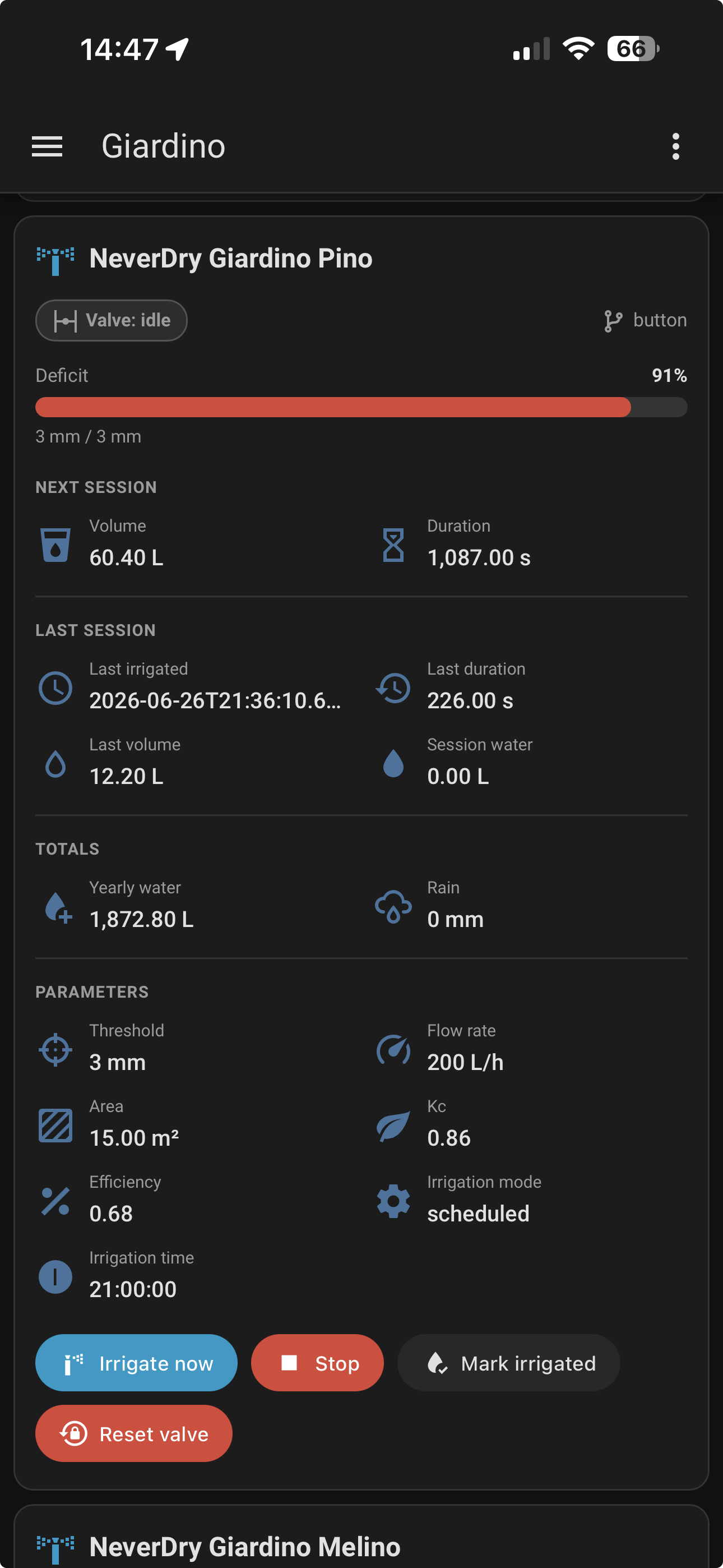
NeverDry ships a custom Lovelace card - auto-registered on install, with no resource to add. It shows up in the "Add card" picker as NeverDry Zone Card: choose a zone to see its valve status, deficit vs threshold, next and last session, totals, parameters, and action buttons - all in one place.
NeverDry keeps track of how much water your soil has lost to heat and evaporation, and how much it got back from rain. The difference is the soil water deficit - how thirsty your garden is.
When the deficit crosses your threshold, NeverDry opens the valve for exactly as long as needed to fill it back up. When it rains, the deficit drops automatically. After irrigation, it resets. Plants that drink more in summer get a higher multiplier - so the lawn and the lavender each get the right amount, without any manual adjustment.
For the technically curious, the full water balance formula is in the README.
| Family | Winter | Spring | Summer | Autumn |
|---|---|---|---|---|
| Lawn / Turf grass | 0.45 | 0.85 | 1.00 | 0.70 |
| Vegetables | 0.30 | 0.70 | 1.10 | 0.50 |
| Fruit trees | 0.35 | 0.70 | 0.95 | 0.55 |
| Ornamental shrubs | 0.40 | 0.65 | 0.80 | 0.55 |
| Herbs (Mediterranean) | 0.30 | 0.55 | 0.70 | 0.40 |
| Citrus / Evergreen | 0.60 | 0.65 | 0.70 | 0.65 |
| Roses | 0.35 | 0.75 | 0.95 | 0.55 |
| Succulents / Cacti | 0.15 | 0.25 | 0.35 | 0.20 |
| Native ground cover | 0.25 | 0.45 | 0.55 | 0.35 |
| Mixed garden | 0.40 | 0.70 | 0.90 | 0.55 |
Want a more detailed drip irrigation setup? Use NeverDry Planner to calculate the irrigated area and the Kc value to copy directly into NeverDry.
First: will it work with your valve?
NeverDry drives whatever Home Assistant already exposes as a switch or a valve, so most setups work. What differs is how much each one can say about the water it actually delivered, and that is what decides whether a run is measured or only timed.
The valve register lists what has been tested, model by model and firmware by firmware, and how to add yours.
never_dry.zip from Releases and extract itcustom_components/never_dry/ to your HA config directoryReleased 2026-07-05
Full release notes on GitHub →
never_dry.set_deficit service - set the water deficit of one zone (or all zones) to an arbitrary mm value; useful for manual calibration and testing.Questions about setup or behaviour? Join the conversation.
NeverDry works out how much water the soil should have left, from the weather and the plants. What it cannot do is measure it. The model is good and it is still a model.
NeverDry Calibrator closes that loop. A soil probe costing a few euros publishes an index from 0 to 100 that is not a percentage of anything, and is different in sand and in clay. The Calibrator takes the deficit NeverDry already computes, watches several irrigation cycles, and learns what that probe's numbers mean in your soil. Like NeverDry, it publishes nothing until it has earned it.
If you already run NeverDry, you own half of an experiment nobody has run yet. The Calibrator's error budget is argued from soil physics and has never been checked against probes in ground that is not the author's. Add a cheap probe, leave it a few cycles, and say what came out. A probe that never calibrates is as useful a report as one that does.
NeverDry is free and open source - the best way to support it is to star it and spread the word:
Know someone with a garden and Home Assistant? Spread the word:
NeverDry is a hobby project for residential use. It is not certified for agricultural, commercial, or safety-critical applications. The ET model is a simplification of the FAO-56 standard and is not a substitute for professional agronomic advice. Always monitor your irrigation system. The authors accept no liability for any damage or loss.
Developed by drake69 with AI assistance (Claude by Anthropic).